What Is a Hub in Data Vault?
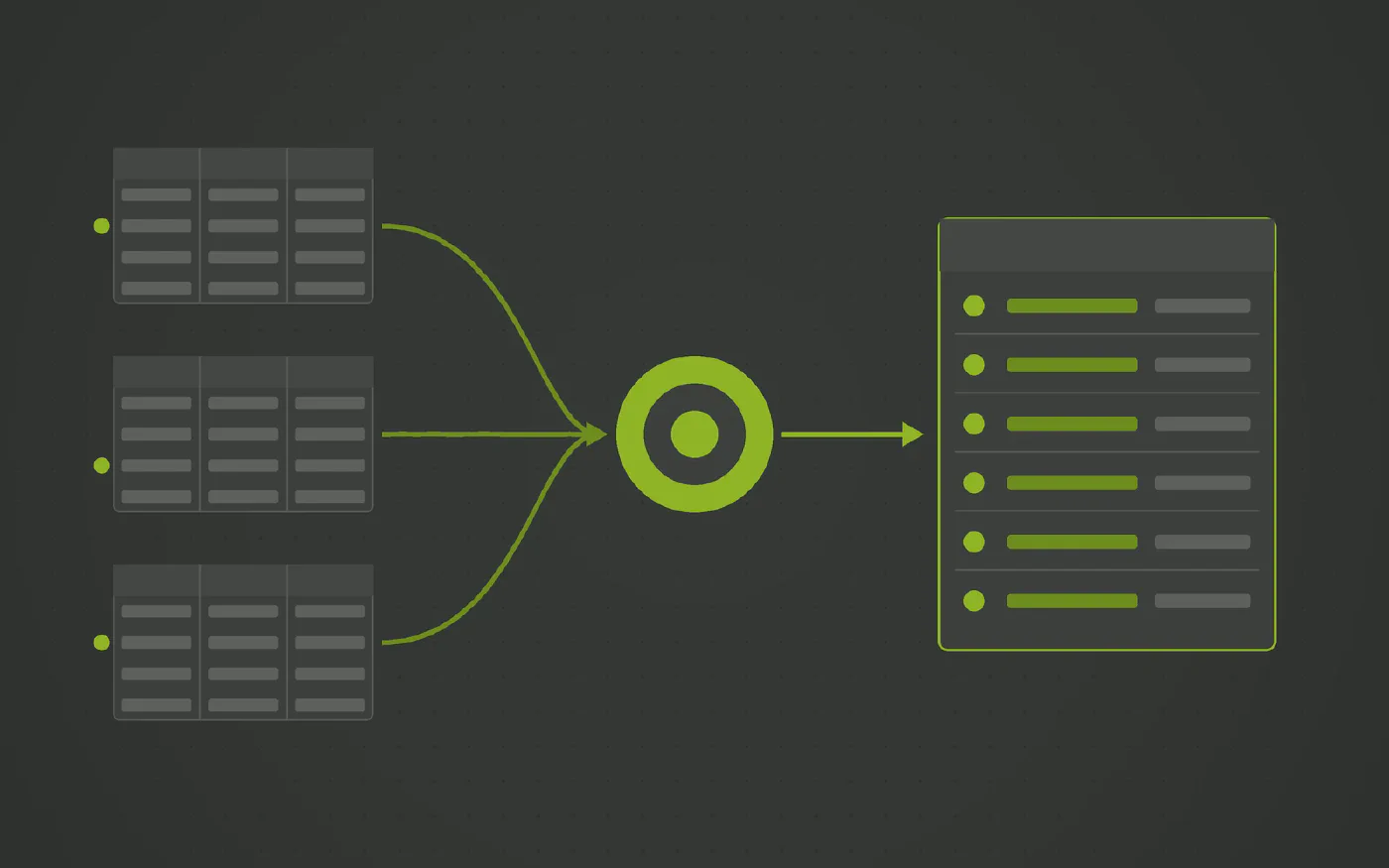
A hub represents one core business concept, such as customer, product or account, as the list of its keys: every one the warehouse has ever seen, each exactly once. It stores identity, not state, and that restraint makes it the point where source system silos collapse.
The data warehouse automation solution trusted by data teams across industries









Does this sound familiar?
- The same customer exists three times in the warehouse, once per source system, and nobody can say which record is right.
- Every new source means renegotiating keys and rewriting joins across the model.
- A source system renumbered its records, and half of the history no longer matches.
Every data warehouse has to answer one question before any other: what are the things this business talks about, and how does it tell them apart? In Data Vault, the answer is a hub.
What a hub is
A hub represents one Core Business Concept: customer, product, account, contract. It is not a copy of a source system table. The customer hub holds every customer key the warehouse has ever received, from any source, each exactly once.
A hub stores identity, not state. It says nothing about the customer: name, address and status live in satellites, and the customer’s orders and contracts are connected through links. The hub only records that this key exists, when the warehouse first saw it, and where it came from.
If you know classical data modeling, you already know the hub
Data Vault does not replace what you learned about data modeling. It reuses it. Start from the conceptual model you would draw anyway: the business concepts and how they relate. Each concept, each entity in your ER diagram, becomes a hub.
Take a classic Customer table in third normal form:
| Classical model | What it is | In Data Vault |
|---|---|---|
Customer entity |
The concept | Hub |
customer_number (natural primary key) |
The identity | Business key in the hub |
name, address, segment |
Attributes describing it | Satellite |
store_id (foreign key) |
A relationship to another concept | Link |
Nothing is lost and nothing new is invented. The entity is split along lines you already know: what identifies it, what describes it, and what it relates to. The hub is the first of those three, which is why the work of finding hubs is the work you would do for any good conceptual model: agree on the business concepts and on how each one is identified.
The anatomy of a hub
A hub has four columns, and no more:
- Hash key. The primary key: a deterministic surrogate, computed as a hash (MD5 or SHA-256) of the business key, plus an optional collision code where two sources could use the same key for different things. In Datavault Builder that collision code is called the Business Key Prefix. Every table that references the hub computes the same value without a lookup.
- Business key. The key that identifies the entity in the business world: a customer number, a VIN, an IBAN. One column, or several for a composite key such as company code plus customer number.
- Load date. When the business key was first registered in the Data Vault.
- Record source. Which operational system delivered the key first.
The Business Key Prefix: same number, different order
The Swiss and the German subsidiary both run their own ERP, and both have an order 1018. They
are two different orders, placed by different customers. Hashed on the order number alone, they
would land on the same hub row, and everything the two systems know about them would be mixed.
The Business Key Prefix keeps them apart. Each source adds its prefix before the key is hashed,
CH|1018 and DE|1018, so the order hub holds two rows, as it should. Use it only where the
same key really can mean different things. Where two systems share a key with the same meaning,
such as a group-wide customer number, they should map to the same hub row without a prefix.
Why we do not trim or upper-case the business key
A common recommendation is to trim and upper-case the business key before hashing it. We do
not recommend that. It makes c-10442 and C-10442 the same customer, and a trailing space
disappears too, even when the difference is a typo in the source. The vault then folds two
entries and their relationships into one without anyone noticing. The hub should keep what the
source delivered; deciding that two keys mean the same thing is a business rule, and it belongs
in a visible place such as a same-as link.
Write once, never update
Hubs are append-only. Each load compares the incoming keys with the keys already in the hub and inserts the new ones. Once a business key is in, it stays forever: no updates, no deletes.
That rule has two consequences. A hub load depends on nothing else in the model, so all hubs can load at the same time. And a failed load can simply run again, because inserting the same new keys twice is not possible.
Where source system silos collapse
The hub is the integration point of the model. If the CRM and the ERP both identify a customer by the same real-world business key, both map to the same hub row, and everything the two systems know about that customer meets there.
That is why the business key is the real design decision. A key the business uses across systems is the best choice. It is not always available in a useful form: a source may only carry its own technical ID, or a key that is reused, formatted differently or missing for older records. How to handle that is the subject of a separate article in this series: technical versus business keys. Where two systems use different keys for the same customer, a same-as link records that they belong together.
What never belongs in a hub
- Descriptive context. Names, addresses, statuses and amounts go into satellites. A hub that collects attributes is a satellite in disguise, and it stops being stable.
- Foreign keys. A
Store_IDinside the customer hub is a relationship, and relationships belong in links. - Attributes posing as concepts. A status, a category or a currency code describes something; it is not a business concept of its own. Transactions are different: in Datavault Builder an order line or a payment gets its own grain hub, which the article on links explains.
- One hub per source. Three customer hubs, one each for the CRM, the ERP and the web shop, rebuild the silos the warehouse was meant to remove.
- Source system surrogate keys, where you can avoid them. An
IDENTITYorAUTO_INCREMENTvalue from one database means nothing in the next system, so leave it out if a business key exists. Sometimes it is the best key there is, for example for the versions of a table the source has already historized, or for the lowest grain of a transaction that nothing else references. There it can be the right choice. The article on technical versus business keys covers when.
What changes with Datavault Builder
In Datavault Builder you define the concept once and map every source to it by defining its business key. The table, the key handling and the loading code are generated from that and run natively on your database, whether that is Snowflake, Databricks, BigQuery, SQL Server, Fabric, Oracle or PostgreSQL.
- The key is a model decision, not a code pattern. You decide what identifies a customer. Writing the hash calculation and the insert logic is not part of that decision.
- New sources map to the same hub. Adding the web shop means mapping its customer number to the existing customer hub, not building a new one.
- The pattern is the same every time. A hand-written hub load gets copied, adjusted and slightly changed with every new source; a generated one does not drift.
What to decide
List the five to ten business concepts your reports actually talk about, and for each one write down the key the business uses to identify it. Where two departments give you different answers, or a source has no usable key at all, you have found the most valuable integration work in the project.
See It Running on One of Your Sources
Book a free demo and bring the connector that costs you the most, in money or in time.
Three Steps to a Hub
-
Define the concept
Name the core business concept, such as customer, product or order, and model one hub for it, whatever the number of sources.
-
Get the data
Connect the source systems that know this concept and load their tables into staging.
-
Map the business key
Map each source’s key to the hub, with a Business Key Prefix where the same number means different things. The loads are generated.
How Datavault Builder Takes the Friction Out of Ingestion
-
Ingestion is built in
Batch, delta and CDC loads from databases, files, REST APIs, NoSQL and Python sources, with streams such as Kafka arriving as micro-batches. Same platform that generates the warehouse, no second invoice.
-
Your schema, not the vendor's
Source tables are mapped to a Data Vault 2.0 model you designed. A new column or a renamed table changes a mapping, not a chain of post-load scripts.
-
Only deltas move
Hubs, links and satellites load what changed. Full reloads stay in staging instead of being reprocessed downstream every night.
-
History is kept by design
Every change is retained as it arrives, so as-was reporting works even where the source overwrites its own rows.
-
Code you never hand-write
Loading, historization and lineage are generated from the model in real time and run natively on Snowflake, Databricks, BigQuery, SQL Server, Fabric, Oracle or PostgreSQL.
-
One platform, up to nine tools fewer
Modeling, ETL, CI/CD, documentation and lineage in one place. That is what makes 14.7 minutes from requirement to production possible.
Recognized by BARC in The Data Fabric Survey 26
Meet Our Expert
Twenty minutes with our Sales Director, and an honest answer on whether this fits your stack.

Matt Collett
Sales Director
Great, pick a time that works for you:
Other Problems This Series Covers
-
Technical Keys vs. Business Keys in Data Vault
Source systems keep the business key in the master record, but every relationship runs on technical keys. Four ways to deal with that, what each one costs, and the pattern we use: a PSA hub for the technical keys, mapped to the business key hub.
-
What Is a Business Key in Data Vault?
A business key is the identifier your employees and customers actually use: the customer number, the invoice number, the contract ID. It is stable, it is shared across systems, and it is what every hub in a Data Vault is built on.
-
What Is a Satellite in Data Vault?
A satellite holds everything that describes a hub: names, statuses, amounts, and every change to them, appended and never updated. It is a slowly changing dimension type 2 without the UPDATE, with a full audit trail built in.
-
What Is a Link in Data Vault?
A link records that business keys belong together: this order belongs to this customer. Datavault Builder covers the classic Data Vault link, and adds a transaction link anchored on a grain hub, which fixes the grain of a transaction and lets transactions relate to each other.
Questions and Answers
- Dan Linstedt. He developed the method in the 1990s and published it around 2000. Data Vault 2.0, which adds hash keys, a methodology and an architecture around the model, followed in 2013.
- The standard reference is Building a Scalable Data Warehouse with Data Vault 2.0 by Dan Linstedt and Michael Olschimke (Morgan Kaufmann, 2015).
- No. Bill Inmon sees Data Vault as an evolution of his third normal form view of the enterprise data warehouse, not as a competing approach.
- No. A dimensional output is often part of a Data Vault implementation: the vault keeps the integrated history, and star schemas are built on top of it for reporting. The same vault can also deliver flat tables or a Unified Star Schema.
- With automation, a third normal form view on top of a Data Vault can be generated completely deterministically. The vault holds the data once, and the 3NF layer is derived from the model. How that works.
- Trying it without automation. Data Vault is built on a small set of strict, repeating patterns, which is exactly what makes it tedious and error prone to write by hand and straightforward to generate. That is why you should use Datavault Builder.
- Yes. Splitting keys, relationships and history into hubs, links and satellites means more tables than a normalized or dimensional model. That is why the physical layer should be abstracted by a model-driven approach like Datavault Builder, where you work on the business model and the tables are generated.
- Book a demo and see a Data Vault built on your own sources, or order a training environment and try it yourself.
- Here. Datavault Builder is a Data Vault automation solution: see pricing or book a demo.
- Datavault Builder is licensed annually, as a subscription to use the software. Perpetual licenses are available on request. The editions and what they include are on the pricing page.