Yale University: Revolutionizing Data Management for 75% Savings and Faster Insights
How Yale University used Datavault Builder to cut 75% of billed consulting hours, expand their internal data team, and accelerate time to insight.
Yale University showcased its Datavault journey at the Data Vault North America User Group in September 2023 — a story of how a major research institution moved from hand-coded data warehouses to a fully model-driven Enterprise Common Reporting platform, and what changed when it did.
Background
Yale recognized the urgent need to consolidate data for improved reporting and analytics, breaking free from the constraints of information silos. This led to the strategic development of an Enterprise Common Reporting platform.
The Data Vault journey
Yale embarked on a journey to implement a Data Vault strategy, focusing on unifying critical data streams in People, Space, Finance, and Academics, while fostering self-service capabilities and preserving historical information.
Design goals. The platform was designed with a focus on flexibility, repeatability, reliability, and high quality — enabling rapid adjustments, replicable processes, data integrity, and dependable reporting.
Simplified processes and metadata-driven code generation for ETL/ELT. Yale embraced simplification by breaking down complex processes, leveraging reusable patterns, and generating code from metadata, particularly using SQL.
In 2016, Yale developed its first DV 2.0 data warehouse — hand-coded. Subsequently, the team decided to use the business model-driven data warehouse automation tool, Datavault Builder, for future data warehouse projects.
Datavault Builder’s impact
Transitioning to Datavault Builder delivered significant benefits across three dimensions:
1. Productivity and time to insights
- Datavault Builder’s model-driven approach resulted in a 75% reduction in used/billed hours compared to manual methods.
- New requirements and data-source integrations were rapidly delivered.
2. Data warehouse extension
- Yale’s data management team expanded significantly with Datavault Builder, enabling support for multiple projects simultaneously.
- Scaling horizontally with domain warehouses proved efficient, manageable, and performant. Each warehouse serves as a “Golden Reference” for a data domain.
- Data Marts combine data from multiple domains for holistic reporting.
3. Team resources
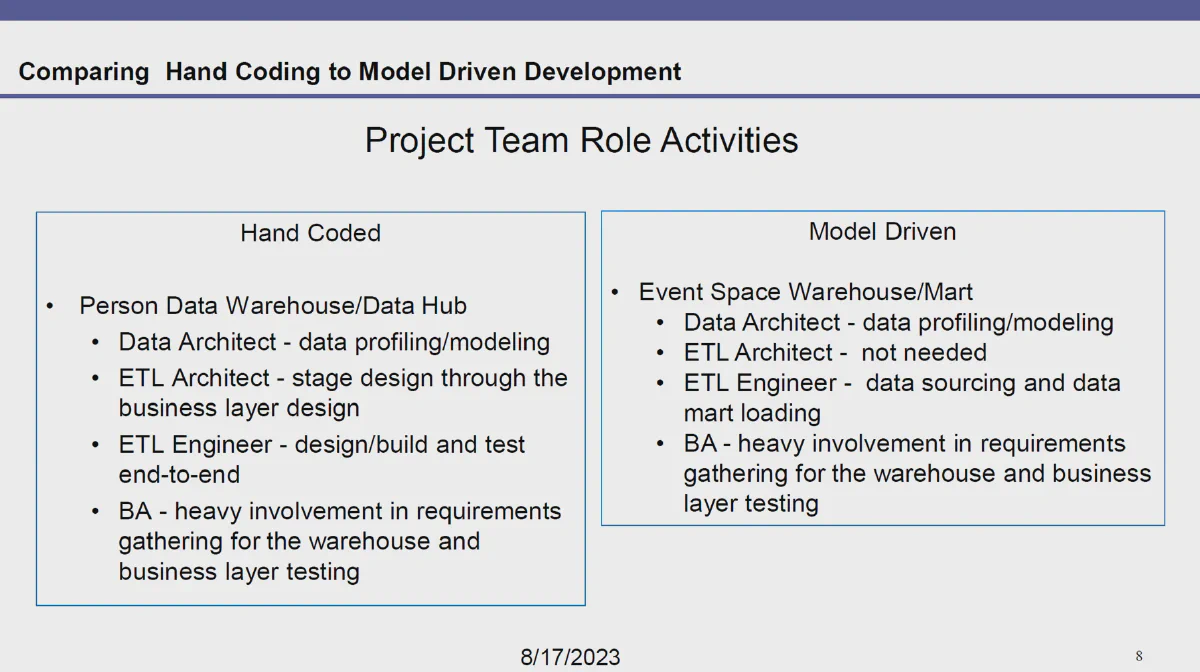
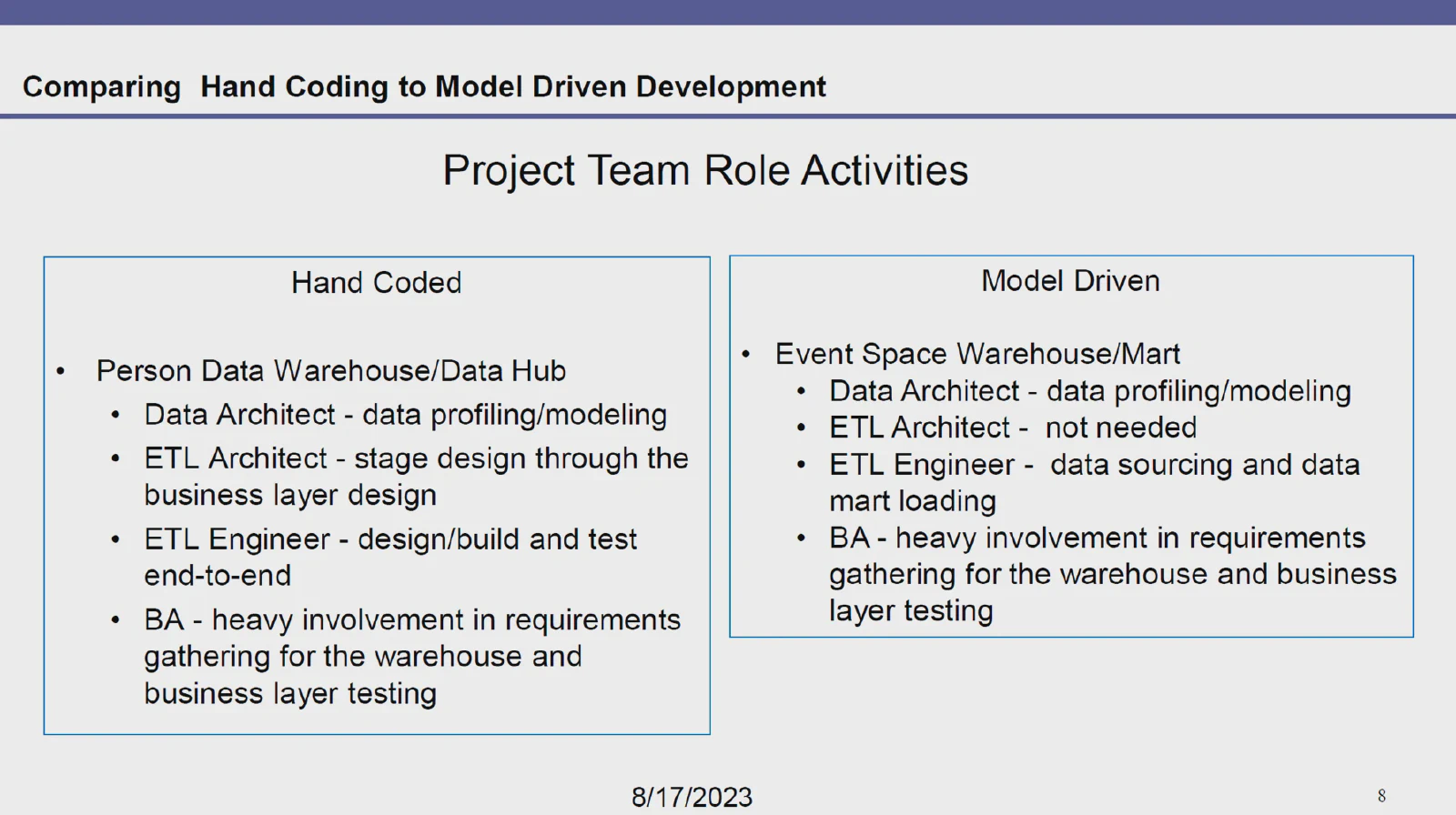
- The adoption of Datavault Builder streamlined roles, eliminating the need for an ETL Architect. Data Engineers focused on staging and data-mart layers while no longer being involved in the design process.
- This reduced role complexity, with Business Analysts playing a more prominent role — making it easier for less skilled and less senior team members to contribute to project success.
Conclusion
Datavault Builder supported Yale in implementing an Enterprise Common Reporting platform, meeting design goals, and minimizing the total cost of ownership.
The 75% cost savings, reduced time to insights, and optimized team roles and composition reduced complexity in team management — proof that the right automation can fundamentally change how a data team operates.
Want to see how Datavault Builder fits your environment? Book a free demo — we’ll walk through your specific use case.
See Datavault Builder in action
20-minute demo. Honest answers on whether it fits your team.
Book a Free Demo